



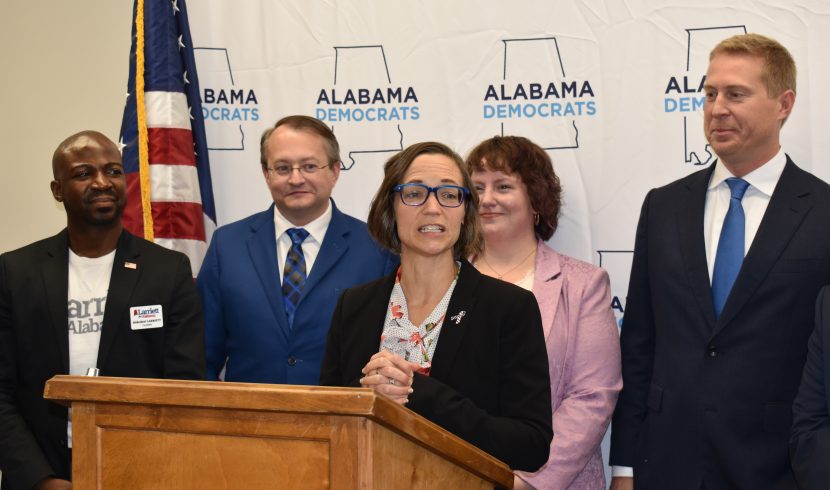
MONTGOMERY, Ala. — Several Alabama Democratic candidates for Congress gathered Wednesday at the party’s state headquarters to sign qualifying documents for the upcoming midterm elections.
This is the first time the Alabama Democratic Party has put up candidates for every congressional seat since 2018, said party Vice Chair Tabitha Isner.
Here are the qualified candidates for the U.S. House and Senate:
U.S. Senator: Dakarai Larriett and Mark Wheeler
U.S. Representative, 1st District: Clyde Jones
U.S. Representative, 2nd District: Shomari Figures
U.S. Representative, 3rd District: Lee McInnis
U.S. Representative, 4th District: Amanda Pusczek
U.S. Representative, 5th District: Andrew Sneed
U.S. Representative, 6th District: Keith Pilkington
U.S. Representative, 7th District: Terri Sewell
Figures and Sewell are incumbents running for reelection. The other five U.S. House seats are currently held by Republicans, and all of them have been solidly red for at least a decade.
District 1 has been represented by a Republican since at least 1989. District 3 has been represented by a Republican since 1997 and by incumbent Mike Rogers since 2003. District 4 has been represented by Republican incumbent Robert Aderholt since 1997. District 5 has been represented by a Republican since 2011, most recently Dale Strong. District 6 has been represented by a Republican since 1993, most recently Gary Palmer.
Though they face an uphill battle to defeat Republicans, the Democratic candidates expressed hope for success in November as affordability concerns weigh on Alabama voters and health insurance premiums increase. They feel these issues might turn out new voters who are not happy with the status quo.
“I have heard many, many times over the last couple of months, ‘I’ve never voted for a Democrat before, but this time I might,’” said District 3 candidate McInnis said.
Several candidates expressed their belief that there are more Alabamians willing to vote blue than some might believe. Wheeler said he’s had conversations with Republicans at his campaign events that end in them saying they could vote for him, especially as people feel pinched with increasing costs.
Recent polling of Republican primary voters said the economy is the top issue for them. Asked about their two biggest concerns regarding increased prices, 50.2% listed the cost of food, 34.3% said health care and 33.8% said insurance.
McInnis said Alabamians are going to be looking for a change in representation. He talked about a beef farmer contemplating selling his herd and a mother whose child lost access to special education because of budget cuts in public schools.
“What we’re seeing is our Republican representatives in Washington are voting against the interest of their constituents, and their constituents are beginning to figure that out,” McInnis said. “We’re seeing a groundswell of discussion at this point that we’re all confident is going to turn into votes in November, that will put Democrats in office where they haven’t been in a good long while.”
Outside of the economy, health care and lack of medical access is a top priority for candidates as they campaign.
U.S. House District 4 candidate Pusczek, a nurse, said she was motivated to run because health care systems across the state are “crumbling.”
In rural Alabama, 60% of hospitals are at risk of closing and 48% are at an immediate risk of closing. That’s the second-highest rate in the nation. Nearly 90% of women in rural areas of Alabama live more than 30 minutes from a birthing hospital.
“At the end of the day, none of these voters, not a single one of them, voted for their loved ones to die on the side of the road because they can’t get to a hospital in time,” Pusczek said. “That is one unifying principle that should be uniting us all, if nothing else right now, is the fact that we have to look out for everyone in our community, and the first step of taking care of each other is making sure that we can live through the next day.”
Alabama Secretary of State candidate Wayne Rogers was also at the press conference.
The deadline for candidates to qualify with the state parties is Jan. 23. Primary elections are May 19.